For research purposes only — not for human consumption — 18+ only
GH Peptides
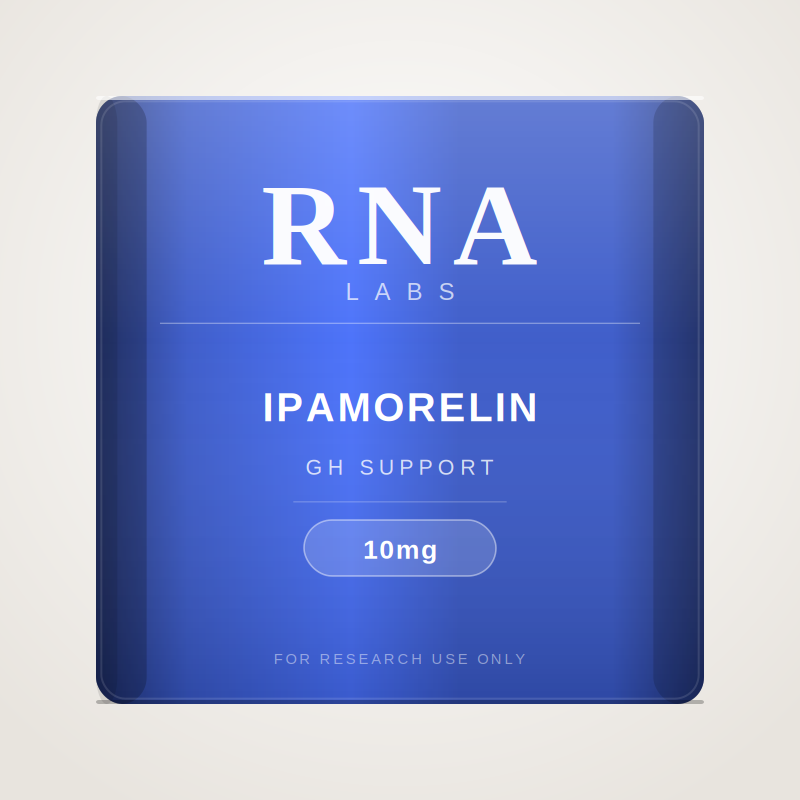
Ipamorelin 10mg
$75.00
Selective GH secretagogue and ghrelin receptor agonist. Research into GH release and IGF-1 elevation.
Use the peptide calculator to determine exact reconstitution volumes and dosing schedules for your research protocol.
Open Peptide Calculator ↗Ipamorelin is a selective fifth-generation growth hormone secretagogue and ghrelin receptor (GHSR-1a) agonist. Developed by Novo Nordisk, it is notable for being highly selective — stimulating pituitary GH release without significant co-secretion of cortisol, prolactin, or ACTH, which distinguishes it from earlier GHRPs (GHRP-2, GHRP-6). This selectivity profile makes ipamorelin a valuable and clean research tool for studying the growth hormone axis without the confounding effects of HPA axis activation.
Molecular Data
Sequence: Aib-His-D-2-Nal-D-Phe-Lys-NH2 | Molecular Formula: C38H49N9O5 | Molecular Weight: 711.85 g/mol | CAS Number: 170851-70-4
Selective GH Secretion
Ipamorelin binds the ghrelin/GHSR-1a receptor in the pituitary with high selectivity, stimulating dose-dependent pulsatile GH release. Unlike GHRP-2 and GHRP-6, ipamorelin does not significantly activate corticotroph cells to release ACTH/cortisol, does not stimulate prolactin secretion, and does not increase appetite to the same degree as ghrelin itself. This clean selectivity profile makes it the preferred GHRP for research applications requiring isolated GH axis stimulation.
GH Pulse Characteristics
Ipamorelin produces physiological GH pulses — rapid spikes in GH concentration that mirror the natural pulsatile pattern of endogenous GH secretion. This pulsatile pattern is important because continuous GH elevation (as occurs with exogenous GH administration) can lead to receptor downregulation and loss of sensitivity. Ipamorelin's pulse-based stimulation preserves GH receptor sensitivity and downstream IGF-1 responsiveness.
Synergistic Combination Research
Ipamorelin is frequently studied in combination with GHRH analogues (particularly CJC-1295 No DAC) to produce synergistic GH release. The combination exploits two independent mechanisms: GHRH fills pituitary somatotroph stores, while GHRP triggers their release. Research demonstrates that the combined effect is significantly greater than either compound alone, making this combination a standard in GH axis research protocols.
IGF-1 and Body Composition
Downstream GH release stimulates hepatic IGF-1 production, which mediates anabolic effects on muscle protein synthesis, lipolytic effects on adipose tissue, and general tissue repair. Animal models show improvements in lean mass, bone density, and recovery from injury following ipamorelin administration — effects mediated primarily through the GH/IGF-1 axis.
Future Research
Ipamorelin continues to be used as a reference compound in GH axis research, particularly in studies comparing GHRP selectivity profiles and investigating the physiological consequences of pulsatile versus continuous GH stimulation.
Reviews
There are no reviews yet.