
For research purposes only — not for human consumption — 18+ only
GH Peptides
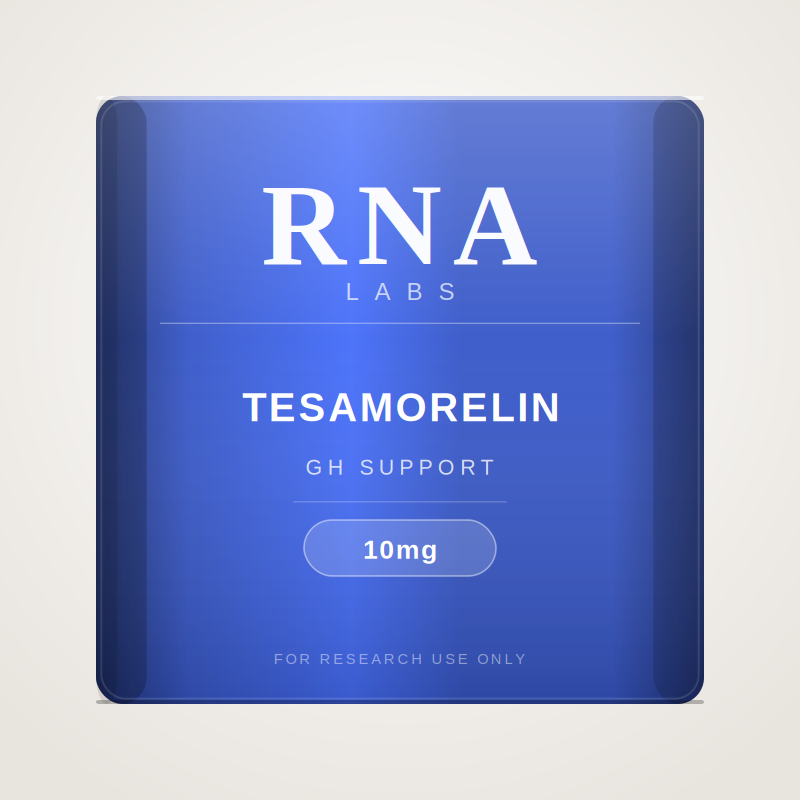
Tesamorelin 10mg
$140.00
Stabilised GHRH analogue with strong GH pulsatile release. Research interest in visceral adiposity.
Use the peptide calculator to determine exact reconstitution volumes and dosing schedules for your research protocol.
Open Peptide Calculator ↗Tesamorelin is a stabilised synthetic analogue of GHRH with a trans-3-hexenoic acid modification at the N-terminus that significantly extends its half-life and metabolic stability compared to native GHRH or sermorelin. It is the only GHRH analogue to achieve FDA approval — licensed as Egrifta for the treatment of HIV-associated lipodystrophy — providing an unusually robust clinical evidence base. Tesamorelin produces potent pulsatile GH stimulation with proven effects on visceral adiposity reduction and IGF-1 normalisation.
Molecular Data
Molecular Formula: C221H366N72O67S | Molecular Weight: 5135.8 g/mol | CAS Number: 218949-48-9
Enhanced Pharmacokinetics
The trans-3-hexenoic acid modification protects tesamorelin from dipeptidyl peptidase IV (DPP-IV) cleavage at the N-terminal Tyr-Ala bond — the primary degradation pathway for native GHRH. This modification extends the plasma half-life to approximately 26-38 minutes (versus ~7 minutes for native GHRH), producing more sustained GH stimulation and higher peak IGF-1 levels compared to unmodified analogues.
FDA-Approved Efficacy Data
Clinical trials leading to FDA approval demonstrated significant reductions in visceral adipose tissue (VAT) in HIV-infected patients with lipodystrophy, with mean VAT reductions of 15-18% over 26 weeks of treatment. Secondary outcomes included improvements in triglycerides, cholesterol ratios, and patient-reported body image. IGF-1 levels normalised in the majority of treated patients.
Visceral Fat and Metabolic Research
Beyond its approved indication, tesamorelin has been studied in non-HIV visceral adiposity, where excess visceral fat is associated with insulin resistance, cardiovascular risk, and metabolic syndrome. Research is also ongoing in age-related GH decline, where visceral fat accumulation is a common consequence of declining GH pulsatility.
Cognitive Research
Emerging research has investigated tesamorelin's effects on cognitive function in older adults. A randomised controlled trial demonstrated improvements in executive function and verbal memory in GH-deficient older adults following 20 weeks of tesamorelin treatment, potentially mediated through IGF-1-dependent effects on hippocampal neurogenesis and synaptic plasticity.
Future Research
Research is expanding into non-HIV metabolic applications, cognitive function in ageing, MASLD, and comparison with newer long-acting GHRH analogues. Tesamorelin's FDA-approved status provides a regulatory framework that facilitates its use as a clinical research compound.
Reviews
There are no reviews yet.