For research purposes only — not for human consumption — 18+ only
GH Peptides
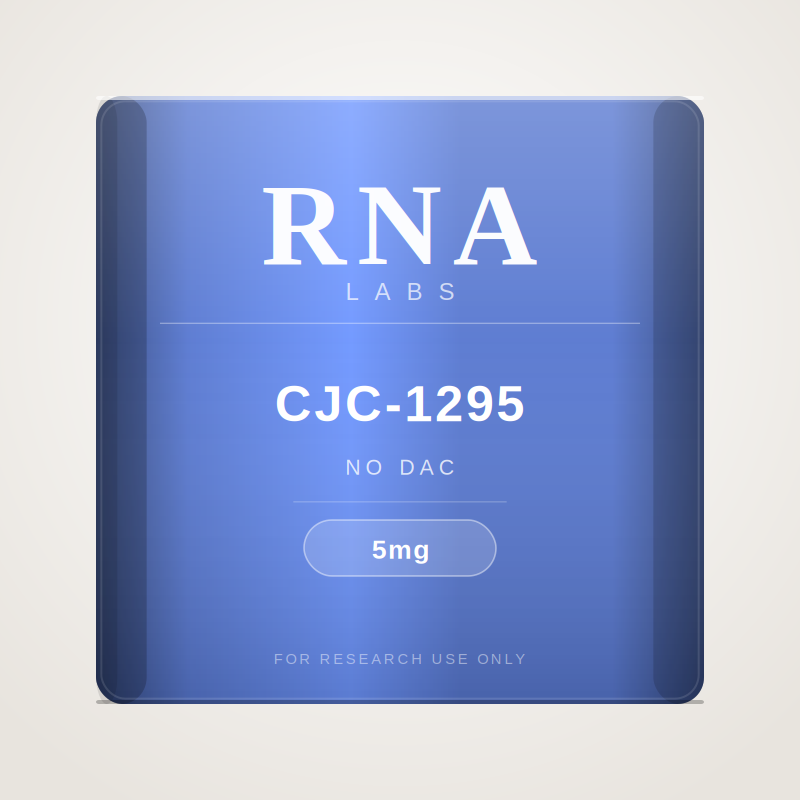
CJC-1295 No DAC 5mg
$80.00
Modified GHRH analogue without Drug Affinity Complex. Short half-life for pulsatile GH research.
Use the peptide calculator to determine exact reconstitution volumes and dosing schedules for your research protocol.
Open Peptide Calculator ↗CJC-1295 (No DAC) — also known as Modified GRF (1-29) or Mod GRF 1-29 — is a GHRH analogue with four strategically placed amino acid substitutions that protect against enzymatic cleavage while preserving GHRH receptor binding affinity. These substitutions extend its half-life to approximately 30 minutes compared to ~7 minutes for native GHRH, while maintaining a relatively short and controllable action window. This makes CJC-1295 (No DAC) the preferred GHRH analogue for research requiring pulsatile GH stimulation that mimics physiological GH secretion patterns.
Molecular Data
Sequence: Modified GRF(1-29) with substitutions at positions 2, 8, 15, 27 | Molecular Formula: C152H252N44O42S | Molecular Weight: 3367.97 g/mol
Protective Amino Acid Substitutions
The four substitutions in CJC-1295 (No DAC) each serve a specific protective purpose: substitution at position 2 (Ala→Aib) prevents DPP-IV cleavage; position 8 (Asn→Gln) prevents asparagine deamidation; position 15 (Gly→Ala) improves stability; and position 27 (Met→Nle) prevents methionine oxidation. Together these modifications extend half-life from 7 minutes to approximately 30 minutes while maintaining full GHRH receptor agonism.
Pulsatile GH Research
Without the Drug Affinity Complex (DAC), CJC-1295 does not bind serum albumin and therefore does not accumulate with repeated dosing. Each administration produces a discrete GH pulse that clears within 2-3 hours, closely mimicking the physiological pattern of GH secretion. This pulsatile profile preserves GH receptor sensitivity and the downstream IGF-1 response — important considerations in long-term GH axis research.
Synergistic Combination with Ipamorelin
CJC-1295 (No DAC) is most commonly studied in combination with ipamorelin (GHRP), where the two compounds act on complementary pathways to produce synergistic GH release. GHRH fills the somatotroph secretory granules while GHRP triggers their release, producing GH pulses substantially greater than either compound alone. This combination is a standard protocol in GH axis research.
Comparison with DAC Version
The primary research distinction between CJC-1295 (No DAC) and CJC-1295 with DAC is pharmacokinetic: the No DAC version produces pulsatile GH release over hours while the DAC version produces sustained GH elevation over days. Comparing the two in parallel experimental designs allows investigation of the differential effects of pulsatile versus sustained GH stimulation on downstream endpoints.
Future Research
CJC-1295 (No DAC) continues to be used extensively in GH axis research, particularly in combination with ghrelin mimetics and in studies comparing different GH stimulation patterns.
Reviews
There are no reviews yet.