For research purposes only — not for human consumption — 18+ only
Anti-Aging
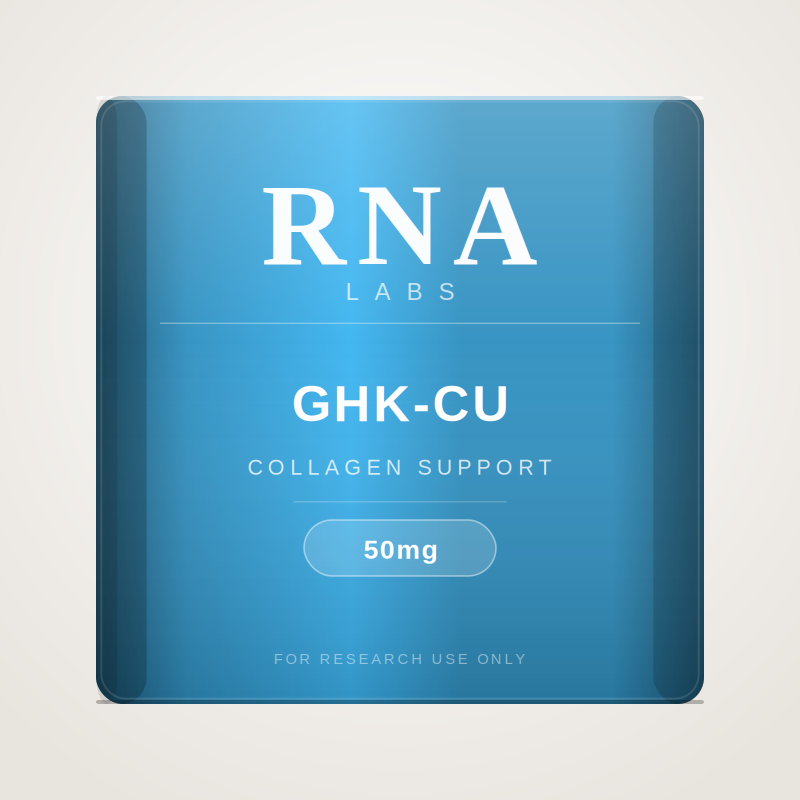
GHK-Cu 50mg
$40.00
Copper peptide studied for skin regeneration wound healing collagen stimulation and anti-inflammatory properties.
Use the peptide calculator to determine exact reconstitution volumes and dosing schedules for your research protocol.
Open Peptide Calculator ↗GHK-Cu (Glycyl-L-Histidyl-L-Lysine copper complex) is a naturally occurring tripeptide-copper complex found in human plasma, saliva, and urine. First isolated by Loren Pickart in 1973, GHK-Cu has since been shown to modulate over 4,000 human genes involved in tissue remodelling, anti-inflammation, DNA repair, and stem cell activation — making it one of the most comprehensively studied naturally occurring peptides. Its concentration in plasma declines significantly with age, from approximately 200 ng/mL at age 20 to 80 ng/mL at age 60, correlating with declining tissue repair capacity.
Molecular Data
Sequence: Gly-His-Lys (complexed with Cu2+) | Molecular Formula: C14H24CuN6O4 | Molecular Weight: 403.90 g/mol | CAS Number: 89030-95-5
Collagen and Extracellular Matrix Synthesis
GHK-Cu is one of the most potent known stimulators of collagen synthesis, activating both collagen I and collagen III production in fibroblasts while simultaneously stimulating the production of elastin, proteoglycans, and glycosaminoglycans. This dual action — building new extracellular matrix components while remodelling damaged ones through matrix metalloproteinase activation — makes GHK-Cu uniquely effective as a tissue repair research tool.
Gene Expression Modulation
Perhaps GHK-Cu's most remarkable property is its broad gene regulatory activity. Studies using gene array analysis have shown that GHK-Cu modulates over 4,000 human genes — upregulating genes associated with tissue repair, anti-inflammation, and stem cell activation while downregulating genes associated with cancer progression, inflammation, and cellular degeneration. GHK-Cu appears to reset aged fibroblast gene expression toward a younger, more regenerative phenotype.
Wound Healing and Angiogenesis
GHK-Cu accelerates wound healing through multiple mechanisms: stimulating VEGF production to promote angiogenesis, activating TGF-β signalling to drive fibroblast proliferation, and upregulating fibronectin and laminin for scaffolding new tissue growth. In animal wound models, topical GHK-Cu consistently accelerates closure times and improves the quality of healed tissue compared to controls.
Hair Follicle and Neural Applications
Research demonstrates that GHK-Cu promotes hair follicle size and stimulates hair shaft elongation in vitro through activation of hair follicle stem cells. Additionally, GHK-Cu has shown neuroprotective properties in neuronal cell models, protecting against oxidative damage and promoting nerve growth factor expression — areas of emerging research interest.
Future Research
GHK-Cu research continues to expand with interest in its epigenetic regulatory mechanisms, potential anti-cancer properties (via inhibition of metastasis-related genes), and neurological applications. Its broad gene regulatory activity positions it as one of the most versatile peptides in research.
Reviews
There are no reviews yet.