For research purposes only — not for human consumption — 18+ only
Anti-Aging
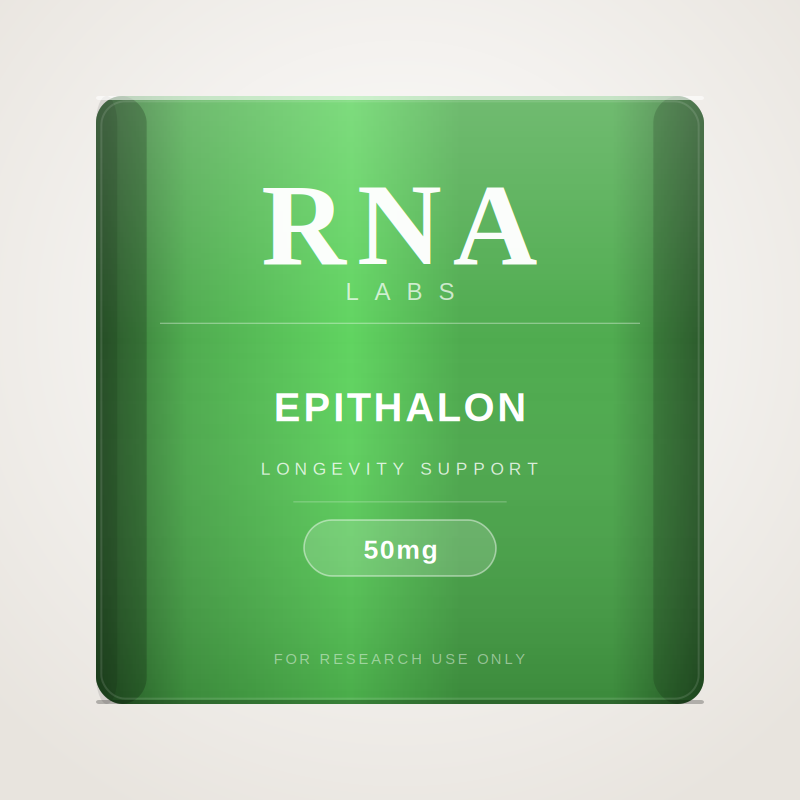
Epithalon 50mg
$120.00
Tetrapeptide studied for telomerase activation and telomere elongation. Research interest in cellular longevity.
Use the peptide calculator to determine exact reconstitution volumes and dosing schedules for your research protocol.
Open Peptide Calculator ↗Epithalon (also known as Epitalon) is a synthetic tetrapeptide (Ala-Glu-Asp-Gly) developed by the St. Petersburg Institute of Bioregulation and Gerontology under Professor Vladimir Khavinson. It is best known in longevity research for its ability to stimulate telomerase activity and elongate telomeres in somatic cells — a property with profound implications for cellular ageing research. Epithalon also regulates melatonin production through the pineal gland and has demonstrated antioxidant, immunomodulatory, and neuroendocrine regulatory properties in animal models spanning over three decades of research.
Molecular Data
Sequence: Ala-Glu-Asp-Gly | Molecular Formula: C14H22N4O9 | Molecular Weight: 390.34 g/mol | CAS Number: 307297-39-8
Telomerase Activation and Telomere Elongation
Epithalon's most studied property is its ability to activate telomerase (hTERT) expression in human somatic cells, promoting telomere elongation and extending the replicative lifespan of cells in vitro. Telomere shortening is a fundamental hallmark of cellular ageing — each cell division results in progressive telomere attrition until the Hayflick limit is reached and cells enter senescence. By activating telomerase, Epithalon offers a research tool for investigating whether telomere extension can delay cellular senescence and extend tissue function.
Pineal Gland and Melatonin Regulation
Epithalon demonstrates significant regulatory effects on the pineal gland, normalising melatonin secretion patterns that typically decline with age. Research in aged animals shows restoration of circadian melatonin rhythms following Epithalon treatment, with downstream improvements in sleep architecture, immune function, and antioxidant defences. This melatonin-regulatory effect positions Epithalon as a research tool in circadian biology and age-related sleep disruption models.
Antioxidant and Immune Effects
Epithalon reduces lipid peroxidation and reactive oxygen species in aged cell models, and has demonstrated immunomodulatory effects including normalisation of T-cell activity and natural killer cell function in aged animal subjects. Russian clinical research spanning 30+ years documents improvements in immune function biomarkers and reductions in age-related inflammatory markers.
Animal Longevity Data
Long-term studies in mice and rats have shown that Epithalon-treated animals exhibit increased median and maximum lifespan, reduced incidence of spontaneous tumours, and better preservation of physiological function into advanced age. Retinal studies in aged animals show preservation of photoreceptor function — an effect attributed to both antioxidant and melatonin-regulatory mechanisms.
Future Research
Epithalon remains one of the most extensively researched longevity peptides, with over 100 published studies. Current research interest focuses on its telomerase activation mechanism, epigenetic effects on ageing-related gene expression, and potential applications in age-related degenerative conditions.

Reviews
There are no reviews yet.